A Publix Money Order Costs About $1, and Western Union Handles the Rest

A Publix money order costs about $1 at the customer service counter, according to Western Union, the company behind it. You pay with cash or a debit card, and Publix itself says only that fees may apply.
Publix sells money orders but doesn’t cash them, and a lost one is Western Union’s to sort out, not the store’s. The same counter sends and pays out Western Union transfers and takes bill payments.
What a money order costs
Western Union’s guide to money orders at Publix, dated February 18, 2026, puts the fee at $1 and says the exact amount may vary by location. Publix’s own financial services page says only “Fees may apply. Please see store for details.”
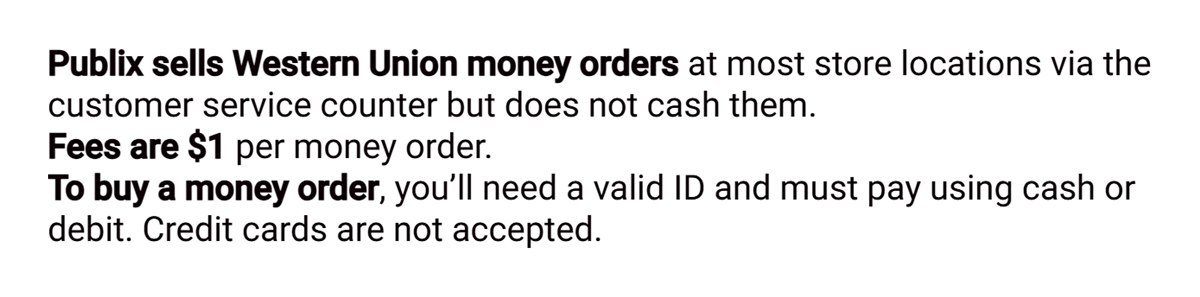
Other sites quote 85 to 99 cents, which we couldn’t trace to either company. Western Union rules out credit cards, and Publix’s terms put money orders among the things a Publix gift card won’t buy.
How much can one money order be for?
Neither Publix nor Western Union publishes a limit for money orders sold at Publix. Western Union’s Kroger guide says most money orders at Kroger and other stores cap at $1,000, and finance sites report $500 at Publix without a source we could check.
We’d plan on $500 until your counter says otherwise. A bigger payment means several money orders, each with its own fee.
What USPS and Walmart charge
Walmart caps its fee at $1 on money orders it says are powered by Western Union. Fees vary by store, so the table shows what each company publishes.
| Where you buy | Issued by | Fee |
|---|---|---|
| Publix | Western Union | $1 |
| Walmart | Western Union | $1 or less |
| Kroger | Western Union | $1.50 or less |
| USPS, up to $500 | USPS | $2.65 |
| USPS, $500.01 to $1,000 | USPS | $3.75 |
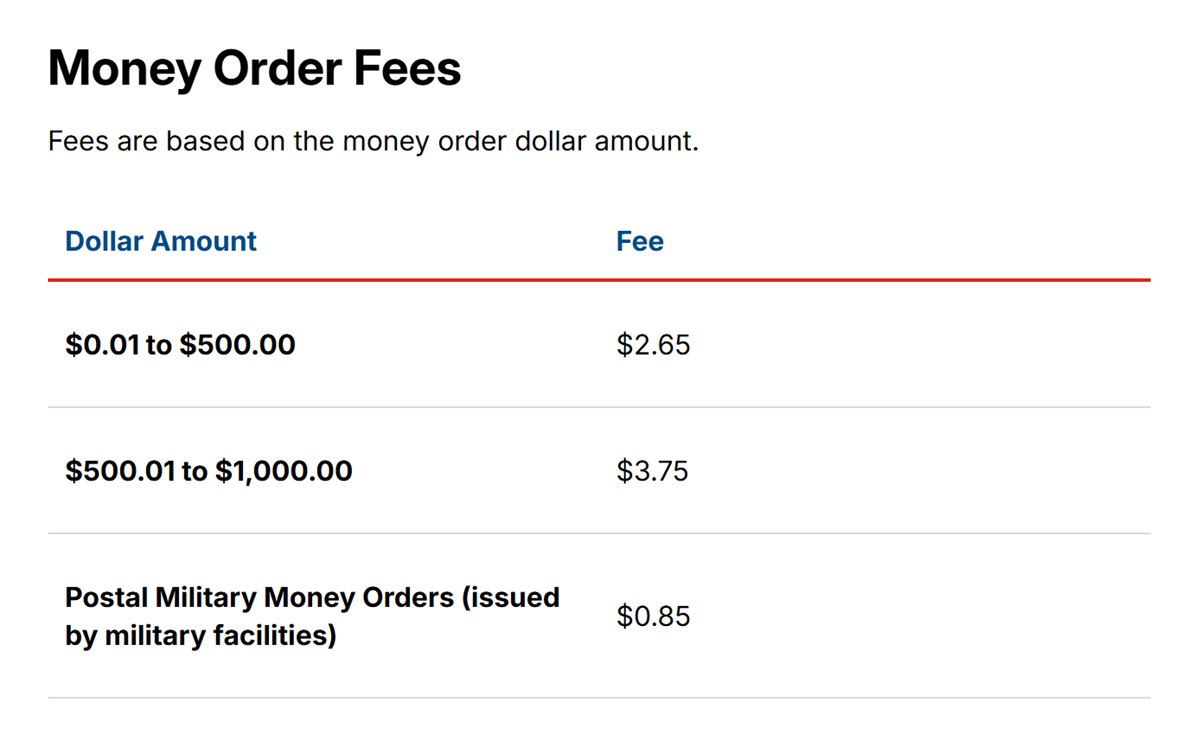
For a $1,500 payment, our calculation comes to $2 or $3 in fees at Publix, depending on the cap, and $6.40 at the post office.
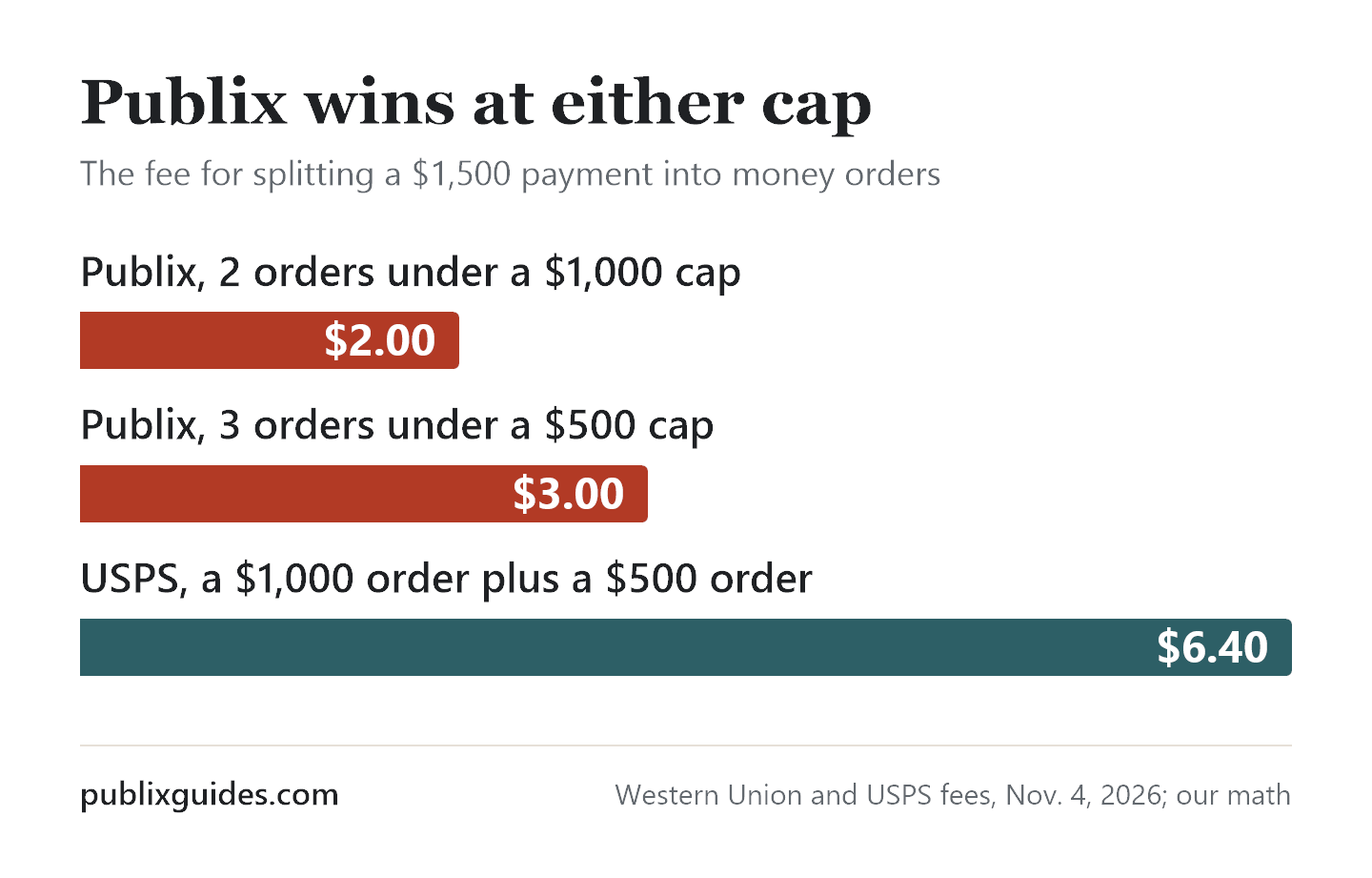
USPS still wins one case. Postal money orders never expire, cash free at any Post Office and carry no listed charge for sitting uncashed, so for a payee who might hold one past a year, we’d pay the $2.65.
Customer service counter hours
Money orders, Western Union and check cashing all sit at Customer Service. Store pages, like the one for Publix’s Southgate Shopping Center store in Lakeland, Florida (#1270), list Money Order Sales and Money Transfers but no counter hours.
Western Union’s locator lists 7 a.m. to 10 p.m. daily for the Publix at Lake Gibson Shopping Center, also in Lakeland, and warns that hours may vary, so treat what time your store closes as the limit. The counter is shut on the three holidays Publix closes.
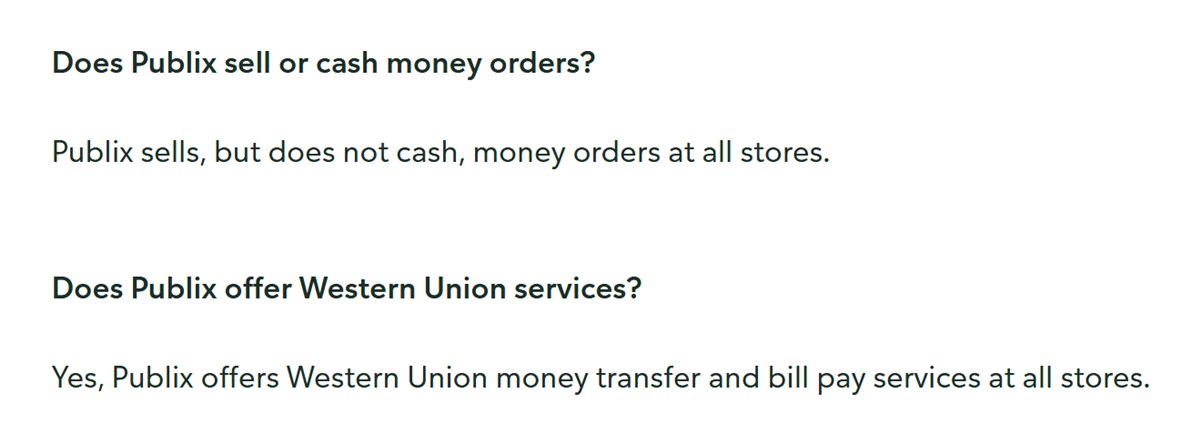
Call ahead in Kentucky. Publix’s FAQ says every store offers money orders and Western Union, but Western Union’s Publix page leaves Kentucky out. In early November, nine of the 10 Kentucky store pages listed both services, all but Terra Crossing in Louisville.
How to fill one out
Fill it in at the counter, before you leave.
- Write the payee’s name on the “Pay to the order of” line, and check the spelling.
- Add your full name and mailing address in the “Purchaser” or “From” section.
- Put an account or invoice number on the “Payment for” line if the payee needs one.
- Sign the front. The back is for whoever cashes it.
- Tear off the receipt and keep it.
Western Union calls that receipt the only proof of purchase and tracking, and you need it for a status check or a refund. Corrections void a money order, so a misspelled name means a refund request and a new one.
If a money order is lost or stolen
Western Union, not Publix, handles lost and stolen money orders, and without proof of purchase neither it nor the store can verify one.
If it hasn’t been cashed, request a refund on Western Union’s money order page with the serial number, amount, purchase date and place, and an image of the money order or receipt. Approved refunds are paid in cash at a Western Union location within about five business days.
The fee comes out of the refund. It’s nothing at $5 or less, $5 under $100 and $15 from $100 up, while USPS charges $23 to replace a lost postal money order.
Western Union’s money order terms say it needn’t replace or refund a lost or stolen one unless you filled in the face when you bought it, reported the loss in writing right away where required, and can supply the receipt. A blank one may be gone for good.
If a thief has already cashed it, the purchaser can file a free forgery claim within 11 months of the date it was cashed, though Western Union doesn’t guarantee recovery.
Holding one too long costs money too. After a year unused, the terms deduct $1.50 a month, counted from the purchase date, where the law allows, up to $126. No Publix state is among the exceptions.
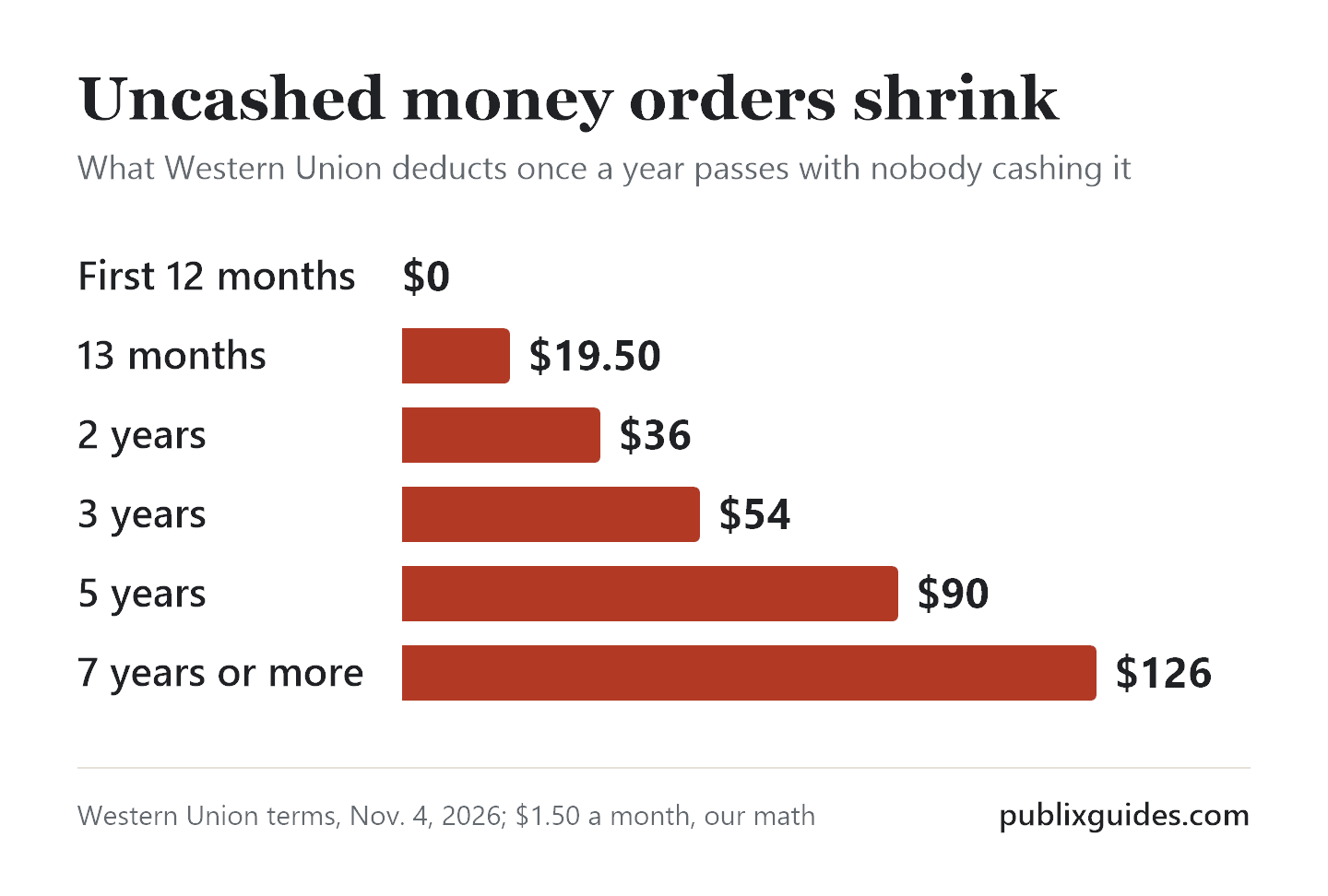
Those dollar figures are our calculation. The terms printed on your own money order are the ones that apply.
Western Union transfers and bill pay
The counter also sends Western Union transfers to more than 200 countries and territories, pays out cash pickups and takes bill payments. Western Union’s Publix page advertises $8 to send up to $1,000 to another Publix in the US, excluding Kentucky, or $12 to any other US agent.

Other amounts get a quote from its price estimator, and Western Union also makes money on currency exchange. A transfer costs more than a money order but generally reaches a pickup counter within minutes, and it works abroad, where a US money order can’t be cashed.
You pay with cash or a debit card. Above $3,000, Western Union asks you to verify your identity, then allows up to $50,000 depending on destination and service, though Publix posts no limits of its own.
For a bill, Western Union asks for your phone number, the company’s name and your account number, with cash or a US bank-issued debit card. We found no published fee for that, so ask first.
Scams that ask for a wire or money order
The FTC compares wiring money to mailing cash. It says never to wire money to someone you haven’t met in person, someone pressing you to pay right away, or anyone who says a wire is the only way to pay.
Its guide to fake check scams describes a stranger’s check for more than they owe you and a request to send some back, sometimes framed as a mystery shopping job testing a store’s money orders or wires. The bank later finds the check is fake, and you owe the money.
Publix’s FAQ says a check that seems to come from Publix for a lottery win or mystery shopping isn’t genuine and asks you to call 800-242-1227 about it.
If you’ve already paid, the FTC says to call Western Union at 1-800-325-6000 and ask for a reversal, though that’s unlikely. For a money order, ask the issuer to stop payment, call the Postal Inspection Service at 877-876-2455 if it was mailed, and report it at ReportFraud.ftc.gov.
What to bring to the counter
- For a money order, cash or debit for the amount plus about $1, a valid ID and the payee’s exact name.
- To send money, a government-issued photo ID, cash or debit, and the receiver’s name as it appears on their ID, plus their country.
- To pick up money, a government-issued photo ID, the 10-digit MTCN, the sender’s full name and the amount expected.
- To pay a bill, your phone number, the company’s name, your account number and cash or debit.
You must be 18 to send or receive money, and Western Union suggests tracked mail for a money order you send by post.